Nexa: Scaling Bitcoin — spoken manuscript

jQrgen · Oslo Blockchain Meetup · Friday 2 October 2026 · doors 17:00, talk 17:30

Talk: 24 slidesSpoken: 3,417 words at 130 wpmDuration: ~30:19 incl. demo and questionsEnds ~18:00 Open the deck · PDF

Cues: [CLICK] next slide or next build step · [PAUSE] · [ASK THE ROOM] · [DEMO: …]. Times are targets from word count.

Slide 0: Welcome
Pre-show

Welcome

Before the talk, from 17:00

(On screen from 17:00 while people arrive. Nothing scripted: walk around and help people install the wallet.)

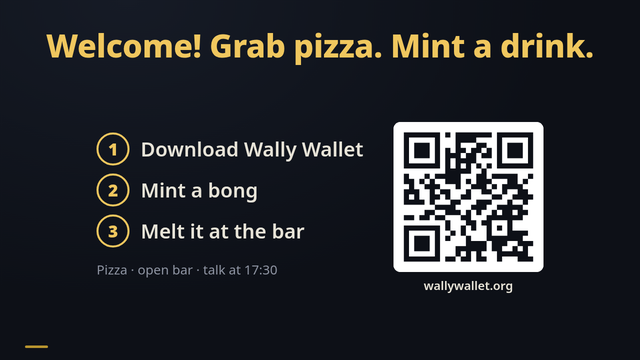
Hi, welcome! Grab a slice of pizza. The bar is open, and tonight it runs on a blockchain. Scan the QR code to download Wally Wallet. In a bit we'll mint drink tokens, "bonger", on the Nexa blockchain. When you want a drink, you melt a token in the wallet and show the screen at the bar. We start at half past five.

Slide 1: Nexa: Scaling Bitcoin
Slide 1

Nexa: Scaling Bitcoin

17:30 · target 1:12 · 155 words

Good evening, everyone, and welcome to the Oslo Blockchain Meetup. [PAUSE] I hope you've found the pizza, and maybe even the bar. If you haven't downloaded Wally Wallet yet, don't worry, there will be another chance at the end, and that's where the drinks come in.

Tonight I want to talk about one question that has followed Bitcoin for more than ten years: how do you make a blockchain that can be used by everyone, every day, without giving up what made Bitcoin special in the first place? My answer tonight is a project called Nexa. The title is "Scaling Bitcoin", and I mean that quite literally. Nexa comes from people who spent years trying to scale Bitcoin, and then built a chain where they could actually do it.

I'll keep the slides light. Mostly pictures. So if something is unclear, that's on me, and you're welcome to shout. This is a meetup, not a lecture. [CLICK]

Slide 2: About me
Slide 2

About me

17:31 · target 1:30 · 194 words

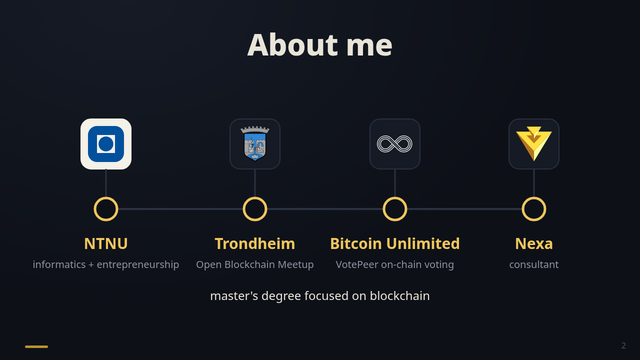
A few words about me, so you know where I'm coming from. My name is Jørgen. I got into blockchain while studying informatics and entrepreneurship at NTNU in Trondheim, and I ended up with a master's degree focused on blockchain.

While I was at NTNU, I started the Open Blockchain Meetup in Trondheim, which is a bit like this one: people, pizza and a lot of questions about what this technology is actually good for. [PAUSE]

Then I became a member of Bitcoin Unlimited, and there I built an on-chain voting system called VotePeer, where you can hold a vote or a poll directly on a blockchain, and anyone can check the result.

Today I work as a consultant in the Nexa project. I help build wallets, tools and examples, and I try to explain the technology to people like you. So I'm not neutral. I'm going to show you something I work on and believe in. But I'll try to be honest about what is live, what is measured, and what is still a plan. You'll hear me say "measured", "implemented" and "planned" quite a lot tonight, and those words are chosen on purpose. [CLICK]

Slide 3: Agenda
Slide 3

Agenda

17:32 · target 0:38 · 83 words

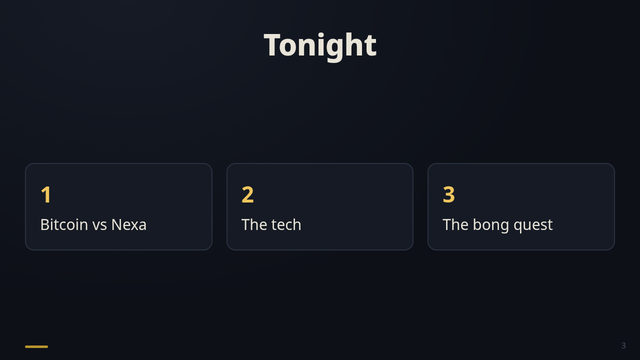
Here's the plan for the next half hour. First, I'll compare Bitcoin and Nexa side by side, so you can see what's the same and what's unique about Nexa. Second, the tech: how Nexa scales, both in software and in hardware, and the slightly wild story of mining. And third, the fun part: the Nexa tech demo quest, which tonight is a bong quest. We'll create a round of drink tokens live on the blockchain, and then you'll use them at the bar. [CLICK]

Slide 4: Bitcoin Unlimited
Slide 4

Bitcoin Unlimited

17:33 · target 1:19 · 172 words

So where does Nexa come from? It starts with Bitcoin Unlimited, a member-run open-source organisation founded in late 2015 to scale Bitcoin on-chain. "On-chain" means: let the blockchain itself carry more transactions, rather than moving most payments to other systems on top.

[ASK THE ROOM] Quick show of hands: who here remembers the block size debate? [PAUSE] A few of you. For everyone else: around 2015 to 2017, the Bitcoin community fought hard about whether blocks should be allowed to grow. Bitcoin Unlimited was firmly on the "let them grow" side, and it wrote a lot of the research on how to do it safely.

The argument against big blocks was a fair one: if blocks get huge, only data centres can run a node, and then you've lost decentralisation. So the real question was never just "bigger blocks, yes or no". It was: how do we make big blocks cheap to send, quick to check, and safe? Keep that question in mind, because the rest of this talk is basically Bitcoin Unlimited's answer to it. [CLICK]

Slide 5: BTC → BCH → NEXA
Slide 5

BTC → BCH → NEXA

17:34 · target 0:47 · 101 words

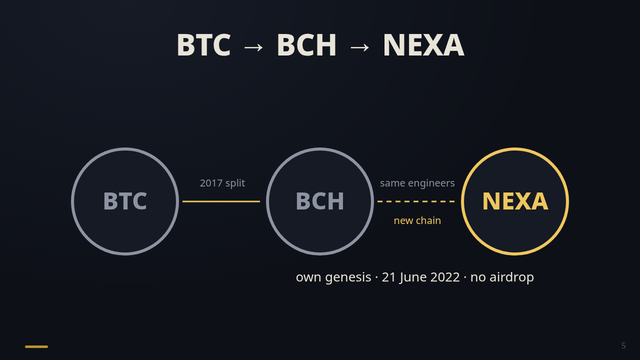
Here is the family tree. The same engineers, and the same codebase lineage, went from Bitcoin, to Bitcoin Cash, to Nexa.

When Bitcoin decided to keep blocks small, Bitcoin Cash split off in 2017 with bigger blocks, and Bitcoin Unlimited built one of its main node implementations. Then the team took everything they had learned and started fresh. And this is important: Nexa is a new chain, not a fork of Bitcoin Cash. It has its own genesis block, it launched on the 21st of June 2022, and there was no airdrop. Nobody got free coins because they held something else. [CLICK]

Slide 6: Bitcoin vs Nexa
Slide 6

Bitcoin vs Nexa

17:35 · target 1:22 · 177 words

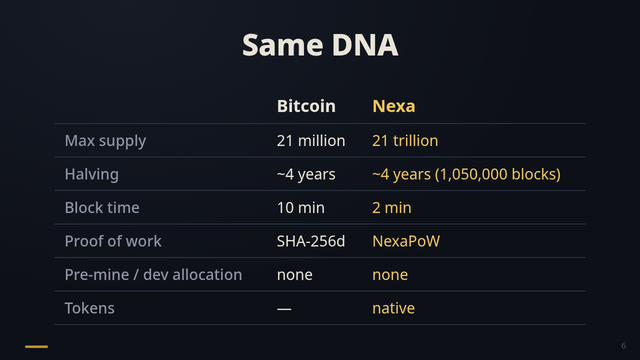
So what does Nexa keep from Bitcoin? Quite a lot, on purpose. Like Bitcoin, the supply is fixed, and new coins are only created by mining. There's a halving: the mining reward is cut in half about every four years. On Nexa that's every 1,050,000 blocks, and the first halving happened on the first of May this year.

The maximum supply is 21 trillion NEXA, where Bitcoin has 21 million. Same shape, just more units, so everyday amounts look like normal numbers. [PAUSE]

And there was no pre-mine and no developer allocation. No VC funding either. Every NEXA in circulation was mined. For me that matters: it's the same fair-launch idea as Bitcoin. If you've looked at crypto for a while, you know how rare that has become. Most new projects reserve a big slice for the team or investors before anyone else can take part.

What's different? Blocks come every two minutes instead of ten. The proof of work is called NexaPoW, not plain SHA-256, and I'll come back to why. And Nexa has tokens built in. [CLICK]

Slide 7: One coin, native tokens
Slide 7

One coin, native tokens

17:36 · target 1:19 · 171 words

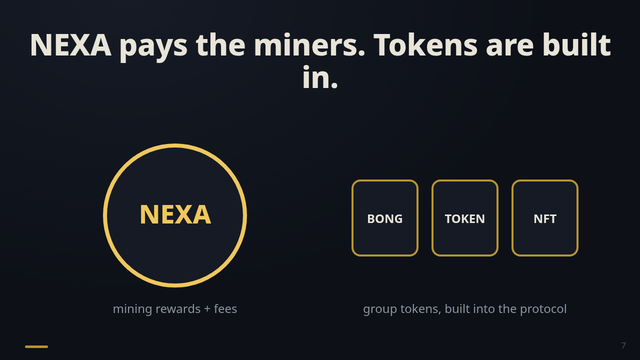
Let's talk about the coin and the tokens. The NEXA coin does the same job as bitcoin: it pays the mining rewards and it pays the transaction fees.

But on top of that, tokens are built into the protocol. They're called group tokens. On Ethereum, a token is a smart contract that someone has to write, deploy and get right. On Nexa, creating, sending, minting and melting tokens is a native operation that every node understands and every miner enforces, just like normal coins. Tonight's drink tokens are exactly that.

People have built all kinds of things with these tokens, including a stablecoin. A stablecoin issued on Nexa is currently hard to buy, because the exchange that listed it was compromised; work on a replacement route is under way. [PAUSE] It's a good reminder that the chain can work fine while the services around it still need to get better.

So the big story for Nexa is scaling, and there are two levers: software and hardware. But first, why scaling is hard. [CLICK]

Slide 8: The blockchain trilemma
Slide 8

The blockchain trilemma

17:38 · target 1:21 · 176 words

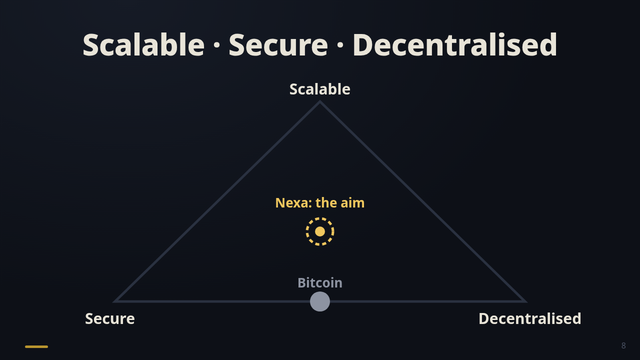
This is the famous blockchain trilemma. You want three things. Scalable: lots of transactions, cheaply. Secure: nobody can cheat or rewrite history. And decentralised: no single company or small group is in control, and normal people can still check the rules for themselves.

The claim is that you can usually only pick two. [CLICK] Bitcoin chose secure and decentralised. It's very hard to attack, and you can run a node at home. But it handles only a handful of transactions per second, and fees go up when it's busy.

Many newer chains chose scalable and fast, often by running on a small number of very powerful servers. [CLICK] Nexa's aim is all three: keep Bitcoin's security model and home-runnable nodes, and still scale. The trick is not to cut corners on security or on who can run a node. The trick is to make each node much more efficient, so the same ordinary hardware can carry a lot more. That's the aim, not a solved problem, and the rest of the talk is how they're going about it. [CLICK]

Slide 9: Two levers
Slide 9

Two levers

17:39 · target 0:36 · 77 words

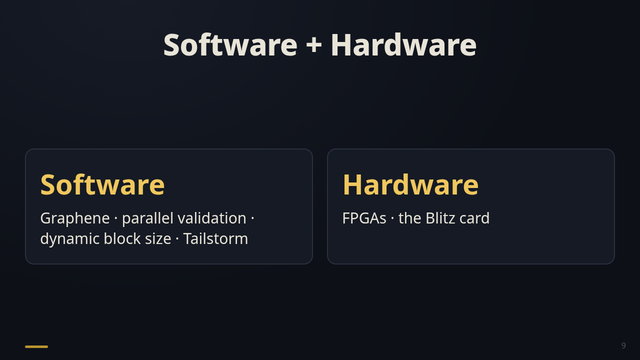
There are two levers. Software scaling: send blocks more efficiently, validate smarter, let block size follow real demand, and confirm transactions faster. And hardware scaling: let special chips do the heavy lifting, so the computer running the node doesn't become the bottleneck. Think of it like video: your laptop doesn't decode video with the main processor anymore, it has a small dedicated circuit for it. Nexa wants the same thing for checking transactions.

Let's start with software. [CLICK]

Slide 10: Graphene
Slide 10

Graphene

17:40 · target 1:30 · 196 words

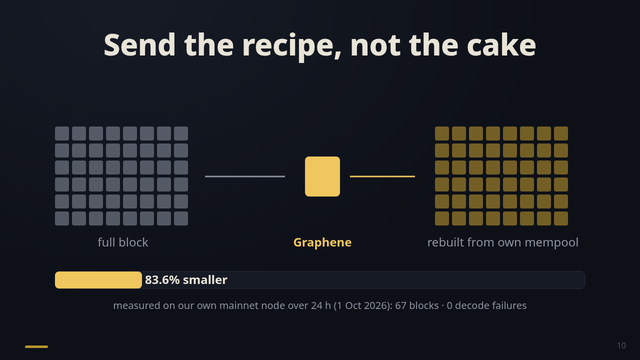
The first trick is about how blocks travel between nodes. Normally, when a miner finds a block, it sends the whole block to its peers. But here's the thing: the peers have already seen almost all of those transactions, because they arrived in their memory pool a few minutes earlier. So you're sending the same data twice.

Graphene fixes that. Instead of the full block, the node sends a tiny summary built from clever data structures called Bloom filters and lookup tables, and the receiver rebuilds the block from transactions it already has. It's like sending the recipe instead of the cake. This comes from peer-reviewed research by Ozisik and others at ACM SIGCOMM 2019, and Bitcoin Unlimited implemented it.

Graphene and its older cousin Xthin are both on by default in the Nexa node. [CLICK] Here's a measurement from our own mainnet node over the last 24 hours: 67 blocks came in via Graphene, the block messages were 83.6 percent smaller than full blocks, and none of them failed to decode. To be honest, mainnet blocks are small today, so that's only about 225 kilobytes saved. But the percentage is what counts when blocks get big. [CLICK]

Slide 11: Parallel validation
Slide 11

Parallel validation

17:41 · target 0:53 · 114 words

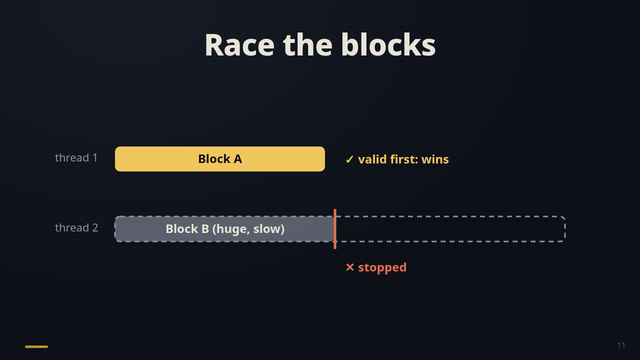
The next trick is parallel validation. Sometimes two miners find a block at almost the same time, and a node receives competing blocks.

When competing blocks arrive, the node validates them at the same time on separate threads. The first valid one wins and the rest are stopped. So one slow or huge block can't stall the node. [PAUSE] Without this, an attacker could craft a block that takes ages to check, and everyone would be stuck waiting for it. With parallel validation, a normal block simply overtakes it. It sounds like a small detail, but when you plan for really big blocks, these are exactly the details that decide whether the network stays healthy. [CLICK]

Slide 12: Dynamic block size
Slide 12

Dynamic block size

17:42 · target 1:07 · 146 words

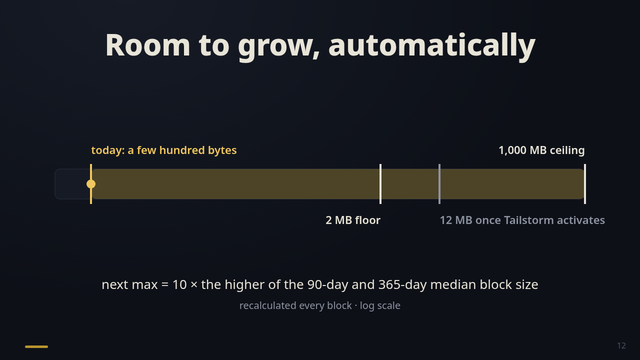
Now, the block size itself. This is the thing Bitcoin fought about for years. Nexa's answer is: don't pick a number, let the chain adapt.

In the current code, the maximum block size is recalculated every block. It's ten times the bigger of two medians: the median block size over the last 90 days, and over the last 365 days. So there's always lots of headroom above what people actually use. It has a floor of 2 megabytes, and a ceiling of 1,000 megabytes, so one gigabyte. Once Tailstorm activates, which I'll explain next, the floor rises to 12 megabytes.

Today, mainnet blocks are only a few hundred bytes, so mainnet sits right at the 2 megabyte floor. Look at the bar: what we use is invisible next to the headroom. If usage grows, the limit grows with it, without anybody having to fight about it. [CLICK]

Slide 13: Tailstorm
Slide 13

Tailstorm

17:43 · target 1:26 · 186 words

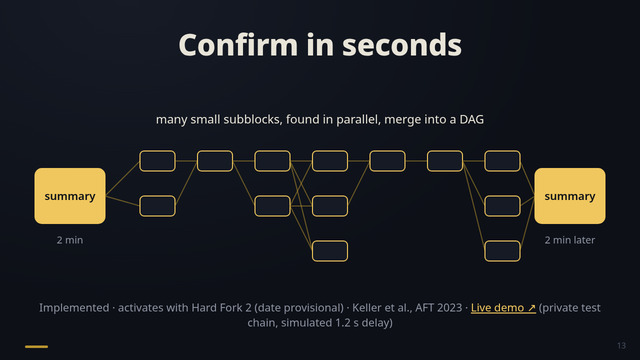
The last software piece is my favourite: Tailstorm. Two-minute blocks are nice, but in a shop you don't want to wait two minutes.

Tailstorm comes from peer-reviewed research that Bitcoin Unlimited supported: "Tailstorm: A Secure and Fair Blockchain for Cash Transactions", by Keller, Glickenhaus, Bissias and Griffith, at the AFT conference in 2023. It lets miners find many small subblocks in parallel between two-minute summary blocks. So transactions confirm in seconds. [PAUSE]

Look at the picture. Each small box is a subblock. Several miners can find one at the same time, and instead of throwing one away, like Bitcoin does with orphan blocks, they all get merged into a little graph, a DAG. Then a summary block closes the round. It's fairer to small miners, and harder to attack.

It's implemented in the node and activates with Hard Fork 2, and the date is still provisional. So: implemented, activation pending.

[DEMO: open the live Tailstorm page, jqrgen.github.io/presentations/tailstorm, and point at the subblocks merging] This live page runs on a private test chain, not mainnet. It uses the mainnet code's setting of 120 subblocks per summary, with a simulated network delay of 1.2 seconds, so you can watch the DAG grow. [CLICK]
Slide 14: Proof of work, side by side
Slide 14

Proof of work, side by side

17:45 · target 1:30 · 194 words

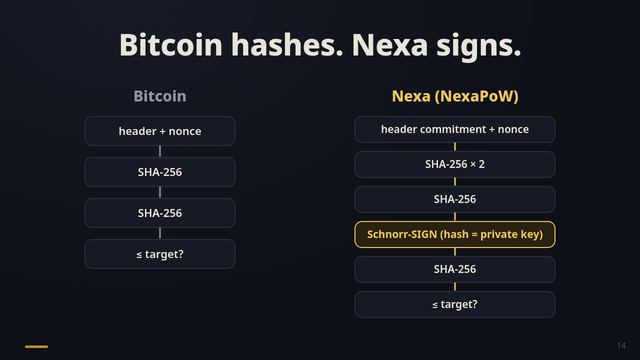
Now hardware, and for that we need to look at proof of work. Mining is basically a lottery: you try a number, called a nonce, hash it with the block header, and if the result is below a target, you win the block.

On the left, Bitcoin: header plus nonce, SHA-256, SHA-256 again, compare with the target. That's it. Bitcoin chips are insanely good at exactly that, and nothing else.

On the right, Nexa. [CLICK] Header commitment plus nonce, double SHA-256, then SHA-256 again. Then comes the twist: the result is used as a private key, and the miner makes a Schnorr signature with it. Then SHA-256 of the signature is compared with the target.

Why? A signature needs elliptic-curve maths, and fast elliptic-curve hardware is the same kind of circuit a node needs to verify the signatures in every transaction. Miners sign and nodes verify, so it's related work, not identical work. The node code even has a comment saying that validation in hardware is what they "really want". So the idea was: let mining money pay for the hardware that full nodes need. Keep that idea in mind, because reality had other plans. [CLICK]

Slide 15: The mining saga
Slide 15

The mining saga

17:46 · target 1:24 · 183 words

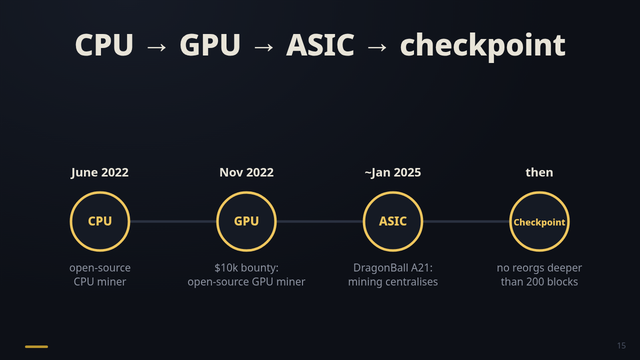
Here's the mining saga in four acts.

Act one. Nexa launched in June 2022, and people mined with the team's open-source CPU miner, on normal computers. [CLICK]

Act two. In late November 2022, community GPU miners arrived and pushed CPU miners out, because graphics cards turn out to be great at elliptic-curve maths. Bitcoin Unlimited posted a ten-thousand-dollar bounty for an open-source GPU miner, and lead developer Andrew Stone published an open-source NVIDIA miner, so that everyone, not just a few, could mine with GPUs. [CLICK]

Act three. Around January 2025 the DragonBall A21 arrived, an ASIC, a chip made just for NexaPoW. About 3.4 gigahashes per second at around 1.8 kilowatts. That's roughly four times more efficient than a top gaming GPU. And mining centralised. [CLICK]

Act four. With hashrate swinging around, the node added a rolling checkpoint: blocks older than 200 can't be reorganised. At two minutes per block, that's roughly six and a half to seven hours. [PAUSE] It limits how deep history can be rewritten. It does not stop a 51 percent attack: a miner with the majority can still rewrite recent blocks. [CLICK]

Slide 16: The ASIC problem
Slide 16

The ASIC problem

17:47 · target 1:00 · 129 words

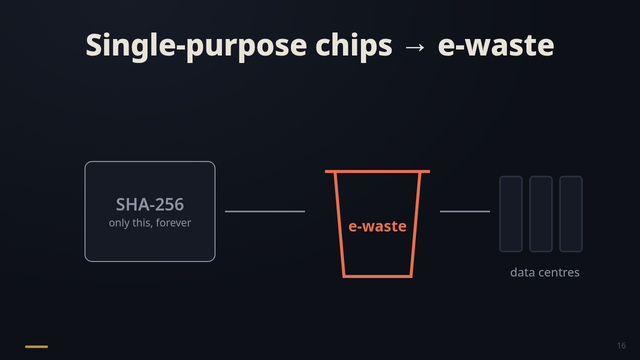
Let's step back. Bitcoin has the same problem, just bigger. Every new generation of Bitcoin ASICs makes the previous one obsolete, and a chip that can only do SHA-256 can't do anything else. It can't run a node. It can't verify a signature. When it's outdated, it's e-waste. And because efficiency is everything, mining moves into big data centres with cheap power.

Nexa set out to avoid this, and honestly, right now it's losing that fight, because an ASIC dominates. So the team is designing the next proof of work. And to be clear, this is not an easy problem. Every proof of work coin that tried to resist ASICs has had to keep adapting. So what I'm about to show you is a design, not a victory lap. [CLICK]

Slide 17: NexaPoW 2
Slide 17

NexaPoW 2

17:48 · target 1:34 · 204 words

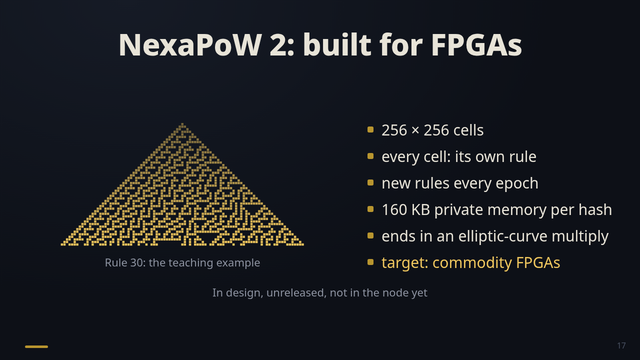
This is NexaPoW 2. It's unreleased and it's not in the node yet. It targets commodity FPGAs. An FPGA is a chip full of tiny programmable logic blocks that you can rewire with a firmware update.

The picture on screen is Rule 30, a famous cellular automaton from Stephen Wolfram. Each row is a line of cells, and each cell looks at its neighbours to decide its next value. Simple rule, chaotic result. [PAUSE]

Rule 30 is the teaching example. The real design is a grid of 256 by 256 cells, where every cell gets its own vetted rule, and all those rules are regenerated from a block hash every epoch, every few months. A CPU could compute the same rule for many cells at once with a bit-parallel trick. With a different rule per cell, that shortcut breaks, and it gets about a hundred times slower. GPUs are hurt mainly by memory: every hash needs 160 kilobytes of private memory. And then the hash ends in an elliptic-curve point multiplication, the same core operation as verifying a signature.

An FPGA does all of this nearly for free. An ASIC that wants to keep up with changing rules would basically have to become an FPGA. [CLICK]

Slide 18: Miners become infrastructure
Slide 18

Miners become infrastructure

17:50 · target 0:53 · 114 words

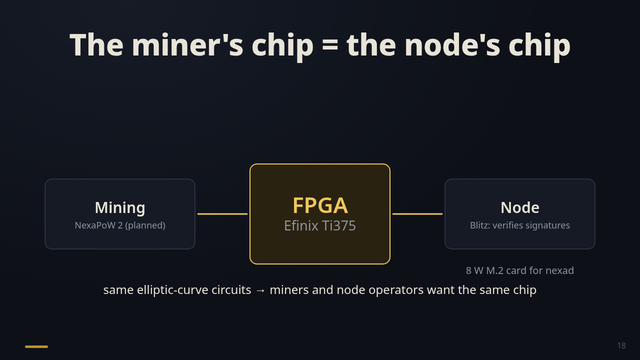
Which brings us to Blitz. Blitz is a separate project: a small 8-watt M.2 card, the kind of slot you put an SSD in, that verifies signatures for nexad, the Nexa node. It's not a mining card.

But here's the link. NexaPoW 2 targets the same FPGA chip as Blitz, the Efinix Ti375. So the FPGA you'd buy to mine already has the elliptic-curve circuits a node needs. [PAUSE] That lines up the incentives of miners and node operators: the hardware that wins at mining is also the hardware that makes the network faster. Speeding up coin lookups, the UTXO database, is a future step, a separate project called CashDrive and a later hard fork. [CLICK]

Slide 19: Where are we?
Slide 19

Where are we?

17:51 · target 1:09 · 149 words

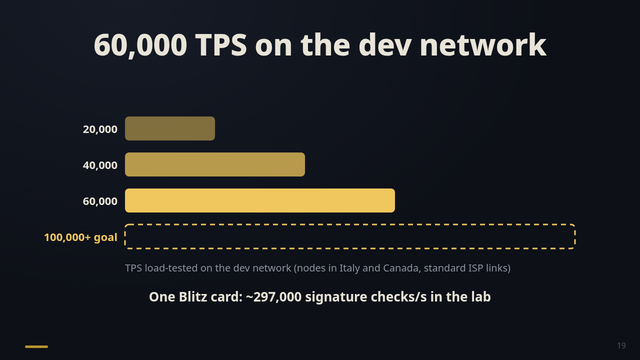
So where are we? On the development network, Nexa has been load-tested at 20,000, 40,000 and up to 60,000 transactions per second, with nodes in Italy and Canada on standard internet connections.

[CLICK] And the hardware side: one Blitz card verifies about 297,000 signatures per second in the lab. That's around three times the signature load of 100,000 transactions per second. So signature checking stops being the bottleneck. UTXO lookups are the next one. The goal is 100,000 transactions per second and more, but that is a goal, not a result yet.

Why does that number matter? Because if you want everyday payments for a whole country, or a whole region, on one chain, you need that kind of capacity. And you want it without asking everyone to trust a handful of big servers. That's the whole point of combining the software tricks with hardware that ordinary people can buy. [CLICK]

Slide 20: Questions?
Slide 20

Questions?

17:52 · target 1:36 · 13 words + 90 s demo/Q&A

That was the tech part. [ASK THE ROOM] Any questions before we get to the drinks? [PAUSE]

(Take one or two questions, about a minute and a half. Park longer ones for the bar.) [CLICK]

Slide 21: Join the community
Slide 21

Join the community

17:54 · target 0:51 · 111 words

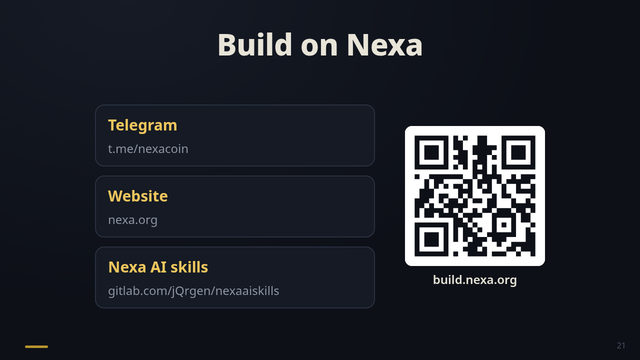
If you want to dig in, here's where to go. The Nexa Telegram group is where the community and developers hang out. Nexa.org has the overview. Build dot nexa dot org is the developer portal, so scan that QR code if you want to build something. And Nexa AI skills is a set of skills that helps AI coding assistants build on Nexa. It's handy if you like to code with AI.

And if you're a student, or you just want to try building something with tokens, come and talk to me afterwards. I'm always happy to help people get their first project running. That's what meetups like this are for. [CLICK]

Slide 22: The bong quest
Slide 22

The bong quest

17:54 · target 1:15 · 162 words

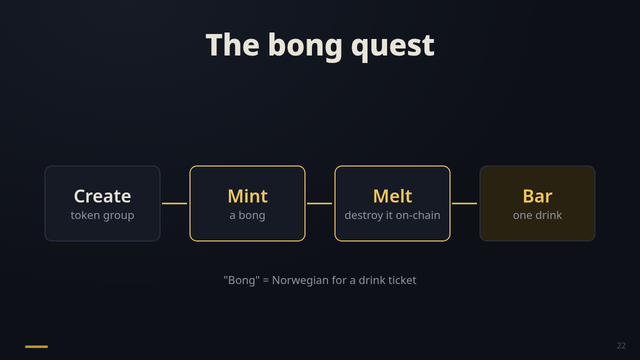
And now, the bong quest. "Bong" is the Norwegian word for a drink ticket. Tonight the drink tickets are tokens on the Nexa blockchain.

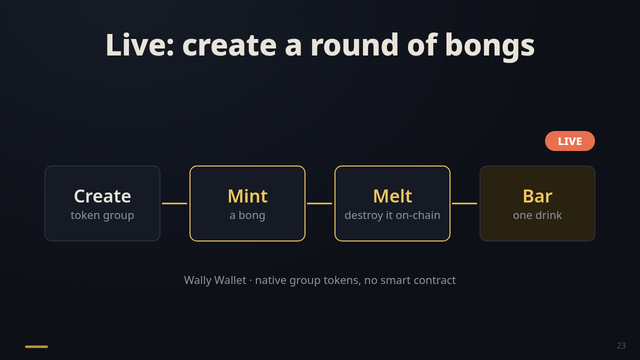
Here's how it works. You have Wally Wallet on your phone. We create a token group for tonight: the bongs. You mint a bong, which means creating a new token in your wallet. And when you want a drink, you melt the bong, which means destroying it on the chain, and you show the screen at the bar. One bong, one drink. Because it's melted on the chain, it can't be used twice.

This is a tiny example, but it shows the real idea. A drink ticket is just a token that can be created, moved and destroyed, with rules everybody can check. The same pattern works for concert tickets, loyalty points, game items or vouchers. And you don't need a developer to write a smart contract for it, because the blockchain already knows what a token is. [CLICK]

Slide 23: Live demo
Slide 23

Live demo

17:56 · target 3:21 · 110 words + 150 s demo/Q&A

Let's do it live. Fingers crossed. [PAUSE]

[DEMO: in Wally Wallet, create tonight's round of bongs: show the token group being created and the mint] So what just happened? I sent a transaction that created a new token group. It's a native token, so no smart contract was deployed. The miners checked the token rules exactly like they check normal coins, and in a moment it's in a block.

[DEMO: mint a bong, then melt one and show the confirmation screen] Minting gives me a bong. Melting destroys it. The melt is a transaction too, so the bar can see that this bong is gone and can't be spent again.

And notice what you didn't see. No gas fee drama, no waiting ten minutes, no contract address to copy and paste. That's what native tokens feel like from the user's side.

(Run the demo, about two and a half minutes.) [CLICK]

Slide 24: Thank you
Slide 24

Thank you

17:59 · target 0:46 · 100 words

That's it from me. Thank you so much for listening! I hope you got a feeling for why I think Nexa is one of the more interesting attempts to scale Bitcoin's design: software that makes blocks cheap to send and check, a block size that follows demand, Tailstorm for fast confirmations, and hardware that turns miners into infrastructure. [PAUSE] The slides and the manuscript are online, so scan the QR code if you want them. Now go mint a bong, melt it at the bar, and come find me if you want to talk about Nexa, mining, or anything else. Cheers!

Sources